
Taj mahal in agra Historical Background

The Taj Mahal, located in Agra, Uttar Pradesh, India, is not just a monument but a timeless symbol of love, architecture, and cultural heritage. Often described as one of the most beautiful buildings ever created, it holds the status of a UNESCO World Heritage Site and is recognized as one of the Seven Wonders of the World. Built by the Mughal Emperor Shah Jahan in memory of his beloved wife Mumtaz Mahal, this masterpiece of Mughal architecture continues to attract millions of visitors from across the globe every year.
The Taj Mahal was commissioned in 1632 AD by Emperor Shah Jahan, the fifth Mughal ruler, after the untimely death of his wife Mumtaz Mahal. Mumtaz, whose real name was Arjumand Banu Begum, was Shah Jahan’s constant companion and advisor, and her passing during childbirth left the emperor heartbroken. To honor her memory and eternalize their love, he envisioned the Taj Mahal as a mausoleum unlike any other.
The construction took around 22 years and was completed in 1653 AD. Thousands of artisans, architects, craftsmen, and laborers worked tirelessly to bring this vision to life. The chief architect was Ustad Ahmad Lahauri, though the project was a collective effort involving experts from across the Mughal Empire and even beyond—skilled workers came from Persia, Turkey, and Central Asia.
Architectural Brilliance
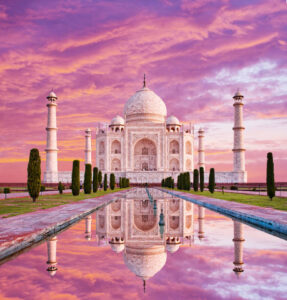
The Taj Mahal is the finest example of Mughal architecture, which blends Persian, Islamic, and Indian styles. Let’s break down its architectural wonders:
1. The White Marble Structure
The central mausoleum is built entirely of white Makrana marble, sourced from Rajasthan. This marble changes its hues depending on the time of day—pinkish in the morning, dazzling white at noon, and golden under moonlight, making it appear almost magical.
2. The Dome
The central dome, often called the “onion dome,” rises to about 73 meters (240 feet) and is one of the most recognizable features of the Taj Mahal. It is flanked by four smaller domed kiosks, giving the structure a perfect balance.
3. The Minarets
Four slender minarets stand at the corners of the platform, each slightly tilted outward to prevent them from falling onto the main mausoleum in case of an earthquake. This ingenious design shows the scientific foresight of Mughal architects.
4. The Calligraphy and Inlay Work
The walls of the Taj Mahal are adorned with intricate calligraphy from the Quran, executed with black marble inlay. The pietra dura inlay work features precious and semi-precious stones such as jasper, jade, crystal, lapis lazuli, amethyst, and turquoise, creating beautiful floral patterns.
5. The Gardens
The Taj Mahal is set amidst a sprawling Mughal charbagh garden divided into four quadrants by water channels, symbolizing the Islamic concept of paradise. The reflection of the mausoleum in the long pool adds to its breathtaking charm.
Symbolism of Love
The Taj Mahal is often referred to as a “monument of love” because it represents Shah Jahan’s eternal devotion to Mumtaz Mahal. Unlike many other grand structures built for political power or religious devotion, this one was built purely out of personal affection. It immortalizes a story of companionship, loyalty, and remembrance, which continues to resonate with people around the world.
Legends and Mysteries
Over the centuries, several legends and myths have surrounded the Taj Mahal:
-
Black Taj Mahal Theory – Some historians believe Shah Jahan planned to build a replica in black marble across the Yamuna River, which would have been his final resting place. However, this theory remains unproven.
-
Hands of Artisans Cut Off – A popular myth suggests Shah Jahan ordered the hands of artisans to be cut off so that they could never replicate the Taj Mahal’s beauty. Historians, however, dismiss this as folklore.
-
Optical Illusions – The Taj Mahal’s minarets are built to appear perfectly straight when viewed from afar. The monument’s symmetrical design also creates fascinating illusions from different angles.
Cultural and Historical Significance
The Taj Mahal is more than a tomb—it is a representation of India’s rich cultural heritage:
-
Mughal Legacy: It showcases the height of Mughal architectural excellence and cultural sophistication.
-
Religious Symbolism: The gardens and inscriptions reflect Islamic concepts of paradise and eternal life.
-
Indian Identity: Today, the Taj Mahal is a global icon of India, appearing in tourism campaigns, films, art, and literature.
Tourism and Economic Impact
The Taj Mahal is India’s most visited monument, attracting over 7–8 million tourists annually. Both domestic and international travelers are drawn to its majestic beauty. It significantly contributes to India’s tourism industry and the economy of Agra.
Agra itself has become a hub of hospitality, handicrafts, and cultural experiences because of the Taj Mahal. Visitors also explore nearby attractions like Agra Fort, Fatehpur Sikri, and the Mehtab Bagh for riverfront views of the Taj.
Conservation Efforts
Being nearly 400 years old, the Taj Mahal faces challenges of preservation. Air pollution, acid rain, and riverbank erosion have caused the white marble to lose some of its sheen, giving it a yellowish tint at times. To combat this, the Indian government and international organizations have initiated:
-
Pollution control measures in the Taj Trapezium Zone (TTZ).
-
Regular cleaning with a special multani mitti (Fuller’s earth) clay pack to restore marble whiteness.
-
Restricting industrial emissions near Agra.
UNESCO and the Archaeological Survey of India (ASI) are constantly monitoring and preserving the monument to ensure it remains a wonder for future generations.
Best Time to Visit
The Taj Mahal can be visited year-round, but the ideal time is October to March, when the weather is pleasant. The full moon nights are particularly special as visitors can experience the Taj Mahal bathed in silver moonlight, an unforgettable sight.
Visitor Tips
-
Entry is free for children below 15 years.
-
Foreign tourists have a separate ticket category.
-
The monument is closed on Fridays for prayers.
-
Avoid carrying large bags or prohibited items.
-
Early morning visits are recommended to avoid crowds and witness the sunrise glow on the marble.
Global Recognition
The Taj Mahal’s unmatched beauty has earned it recognition as:
-
A UNESCO World Heritage Site since 1983.
-
One of the New Seven Wonders of the World in 2007.
-
A recurring feature in global art, films, and literature.
The Eternal Resting Place
Inside the mausoleum lie the cenotaphs of Mumtaz Mahal and Shah Jahan. Interestingly, the cenotaphs are ornamental, while the actual graves are located in a chamber below, in accordance with Islamic traditions.
Conclusion
The Taj Mahal in Agra is more than just a magnificent piece of architecture—it is a story carved in marble, a poetic expression of love, and a cultural jewel of India. From its dazzling dome to its intricate inlays, from its lush gardens to its spiritual symbolism, it continues to inspire awe, admiration, and romance.
As Rabindranath Tagore once described it, the Taj Mahal is “a teardrop on the cheek of time.” Its beauty is eternal, and its message of love universal. Visiting the Taj Mahal is not just a journey through history, but also an experience of timeless emotion and human creativity.
Taj Mahal – The Eternal Symbol of Love
The Taj Mahal, located in Agra, Uttar Pradesh, is one of the most iconic monuments in the world and a UNESCO World Heritage Site. Built by Mughal Emperor Shah Jahan in the 17th century, it stands as a timeless symbol of love in memory of his beloved wife Mumtaz Mahal.
Made of pristine white marble, the Taj Mahal is admired for its stunning architecture, symmetrical gardens, and intricate carvings. At sunrise and sunset, the monument glows in magical hues, leaving visitors mesmerized.
Millions of travelers from around the globe visit Agra every year to witness this wonder, often called one of the Seven Wonders of the World. Beyond its beauty, the Taj Mahal is also a reminder of India’s rich history and cultural heritage.